Wednesday, March 6, 2013

Former People The Final Days of the Russian Aristocracy by Douglas Smiith

 
The focus of the Russian Revolution usually leads us straight to the Ekaterinburg and the assassination of the Tsar and the murders of his family.  The Bolsheviks tried to eliminate nearly every member of the Imperial Family, but their real goal in establishing a new (and repressive) society was to destroy and eliminate the ruling classes: Russia's own aristocracy.

Douglas Smith's Former People The Final Days of the Russian Aristocracy (Farrar, Straus and Giroux: $30.00) is a heart-rendering and passionate accounting of an entire class of people: the titled, wealthy landowners being wiped away largely through murder and exile.

Smith focuses on two families: Sheremetevs and the Golitsyns, although all of Russia's noble families were deeply affected by the wrath of the revolution.

At one moment, these families were at the center of Russia's art, culture and politics.  They were educated, they married well, and they were rich.  They also cared deeply about their country, and, at first, could not comprehend that their world was completely erased by the Soviets.   They became the "former people" or "class enemies" who were to be eradicated from the new Soviet Union.

This mean exile, poverty, imprisonment and death.  A small number of the these families were able to leave Russia, but most chose to stay, believing that their world would survive.  It didn't.  From inexplicable wealth to hunger,  the former people endured tragedy and terror. They learned to hide their fear, and trust for the new system -- and justice -- was non-existent. 

Several of the younger descendants embraced the growing power of the Soviet Union.  They were eager to show their pride in the new society's accomplishments, but it was all for naught.  Their world was brought to an end by an unjust and unfair system.  

Douglas Smith, a former State Department employee, is an analyst on Soviet history and politics.    The amount of painstakingly honest research is utterly outstanding.  Smith's bibliography is prodigious and breathtaking, especially as this is the first book to focus on the demise of Russia's princely families.

Former People is a must read, a truly definitive book that defines a standard for a serious,  well-researched history-cum-biography-cum social commentary.  This book should win a few awards.  It definitely a superb book that should be read ... one cannot fail to be drawn into the stories of truly proud people who were stripped of everything.




Thursday, February 28, 2013

A Prince Among Stones by Prince Rupert Loewenstein


Sometimes you fall into an opportunity that will not only change your life, but also the lives of the people you are advising.

Prince Rupert zu Loewenstein, a British educated German prince (albeit a member of the morganatic branch of the Loewenstein-Wertheim-Freudenberg family, spent thirty seven years as financial adviser to the Rolling Stones, one of the mega rock groups.

Rupert, whose parents were divorced when he was a child, was educated at Oxford.  He did not have a lot of money, but that would change when he entered the financial business, first as a stockbroker for the American firm, Bache & Co., and then with several friends, purchased Leopold Joseph and Sons, a private investment bank.

The prince married Josphine Lowry-Corry, a young aristocrat without a trust fund.  Although her family did not approve of her marriage to a Roman Catholic, Josephine converted several months after her marriage. 

The young couple moved in the very elite of circles, which included royalty and the very rich, which is not surprising due to the Prince's only family connections.  His cousin was Prince Johannes of Thurn and Taxis.  His mother, Bianca, was a descendant of Pedro I of Brazil through his legitimated daughter, Isabel Maria.

It was at a party where he first met Mick Jagger, the lead singer for the Rolling Stones.  The group was already well known.  They sold millions of records and their concerts were hot ticket items.  Someone was making money off the Stones, but Mick and his few band members were not making money.  The band was in serious financial trouble.
The world of investment banking would soon prove to be not enough for Prince Rupert. Signing on as the Stones' financial adviser, Prince Rupert was able to bring his particular skills to a "rat's nest" of truly serious problems.  

The group was tied to one contract and wanted to extricate themselves in order to move on.  It took some years to put the Rolling Stones on the right financial path.  The group was making money (not going to the Stones), but not paying taxes because of all the bad financial decisions that had been made before Rupert signed on. 

Prince Rupert retired in 2008 after spending thirty seven years turning the Stones into a financial success for all ... including himself.

 Now five years later, the nearly 80 year old prince has written a charming memoir,  A Prince Among Stones (Bloomsbury: $27.00) that weaves a jovial tale of a well-educated but not well-funded prince who found his financial métier.

Although Prince Rupert moved in the Rolling Stones' circle, he was not a fan of rock music (preferring classical) and never even played a Stones record.    He advised the group on how to build their own financial empires, after they became tad exiles in France.  He bought a villa in Mustique (Villa Zinnia) and advised others to do so as well.

Rupert, a devout Roman Catholic, convinced the Stones that it was important to donate some of their concert earnings to charity.  He was active in the Sovereign Order of Malta and other Roman Catholic organizations.

He had to deal with the drug issues as Mick's divorces.  Bianca did not listen to him, and ended up with a lot less.  Jerry Hall, who nicknamed the prince as Rupie the Groupie, was more receptive to his financial acumen.

His marriage to Josephine Lowry-Corry took place at the Brompton Oratory in July 1957.  The bride wore white although the gown was designed to hide the fact that she was pregnant.  Their first child, Rudolf, was born four months later.  Konrad was born in 1958, and Dora arrived in 1969. 

Dora is married to an Italian count, and handles the Stones' PR.  Rudolf and Konrad are Catholic priests.

A Prince Among Stones offers insight into what it takes for a group to make money (and not being scammed, which is what happened before Rupert stepped in.)  Prince Rupert moved in the right circles, and got invited to the right parties.  He was able to parlay his skills into a career that seemed inexplicable to most.  A German prince, who never liked rock music, was able to built a rock empire for Mick Jagger and the Rolling Stones.

But the prince does not forget about his own life and his family history.  The Appendix: The Ancestry of Prince Rupert zu Loewenstein-Wertheim-Freudenberg was written by noted royal expert Guy Sainty.

I certainly got a lot of satisfaction after reading A Prince of Among Stones.


The UK edition is published by Bloomsbury.

Tuesday, February 19, 2013

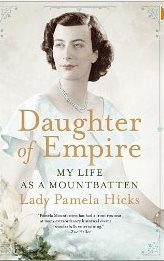
Daughter of Empire Life as a Mountbatten by Pamela Hicks


We can thank Lady Pamela Hick's younger daughter, India Hicks, for persuading her mother to pick up a pen and write her memoirs. The first volume India Remembered was published in 2007.

 Lady Pamela's first book focuses on India's independence, and roles played by her parents, Lord and Lady Mountbatten, as Viceroy and Vicereine. Now in her second book,  Daughter of Empire, Lady Pamela offers an open door to her life as a Mountbatten.

Pammy and her older sister, Patricia, have lived very priviledged but largely unorthodox lives. Lady Pamela's mother, Edwina, came from a very rich family, allowing her father, Lord Louis Mountbatten, to pursue his naval career combined with the comfort of a social position backed by his wife's bank account.

Lady Pamela was born in 1929, five years after her sister, Patricia.  She acknowledged that she and her sister barely saw their mother, as they were raised by nannies and governesses.  Lady Louis (later the Countess Mountbatten of Burma) had her charity work, but she was also a lost soul, at times,  She got bored when Lord Louis was at sea, so she took lovers. 

Lord and Lady Louis had what we would call an open marriage.  Louis was often at sea, leaving his wife with a lot of free time.  He was hurt by his wife's betrayal but eventually came to terms with it.  The marriage survived in spite of the infidelity.  They remained an effective team especially during the second world war and in India.

Lady Pamela offers an honest portrait of her parents. Having her mother spend most of a year traveling with her lover, Bunny Phillips (who later married Georgina Wernher, the eldest daughter of Lady Zia Werhner, whose sister, Nada, was married to Lord Louis' elder brother, George).  Bunny and Louis' longtime companion, Yola, became members of the family.

Lady Louis was definitely a hands-off mother, During one trip with her lover and her younger daughter (and nanny),  Lady Louis left Pammy and the nanny at a hotel in rural Hungary for some months because Lady Louis forgot where the hotel was located.

Lady Pamela has had a front-row seat in India where her father negotiated the separation of India and the birth of two independent nations: India and Pakistan.  She witnessed the marriage of her first cousin, Prince Philip of Greece, to Princess Elizabeth in 1947, and she served as Elizabeth's lady-in-waiting on the 1952 tour that included a stopover in Kenya.

She watched as Prince Philip took his wife for a walk, and told her that her beloved father was dead, and she was now Queen.  When they returned to the Sagana Lodge, Pamela wrote: "I instinctively gave her a hug but quickly, remembering that she was now Queen, dropped into a deep curtsy." 

Daughter of Empire is truly introspective, wistful, at times.  Lady Pamela's young life was shaped by historical turmoil as well as the turmoil of her parents' marriage.   Yes, her life was privileged, but I think Lady Pamela would think that it has been a privilege to live the life she has lived.

It has been an extraordinary life as a Mountbatten, but Pamela, much her parents were "slightly unsettled" by Pamela's unwillingness to embrace a public life. She was in her late 20s, unmarried, although she had turned down dozens of proposals.  One night in 1959, she went to a cocktail party, where she met a man who "bowled" her over.  His name was David Hicks, an up and coming interior designer.   They married in 1960 and became the parents of three children.

Daughter of Empire was published by (Weidenfeld & Nicolson: L20.00).

The book is scheduled to be published in the US in September 2013 by Simon & Schuster ($26.00)

Saturday, February 9, 2013

Prince Rupert Löwenstein dishes on Mick!

Prince Rupert zu Löwenstein has written his memoirs, A Prince Among Stones: That Business with the Rolling Stones and Other Adventures,  which may prove to be of interest not only to royal readers, but also to rock fans.  For 40 years, Prince Rupert served as the financial advisor to Mick Jagger and the Rolling Stones.  Bloomsbury is the publisher for the US and UK editions.


Wednesday, February 6, 2013

The Other Grand Dukes


The Other Grand Dukes by Art Beeche and a few other people is now available through Amazon,  The price is $43.95.
I am one of the few other people who contributed to the book as I wrote the chapter on Grand Duke Michael Mikhailovich. 


Wednesday, January 30, 2013

In Destiny Hands by Justin C Vovk


Canadian biographer Justin C. Vovk rightly credits biographer Julia Gelardi for providing the inspiration and format that led to the publication of his first book, In Destiny's Hand (IUniverse:$25.95).  Julia's most  recent book is From Splendor to Revolution.

Vovk's book follows this format, which chronicles the lives of five of Empress Maria Theresa's children, all of whom became sovereigns or consorts, through the single narrative. 

Empress Maria Theresa and her husband, Franz, were the parents of sixteen children.  Two of their sons, Joseph II and Leopold II,  were Emperors of Austria.  Amalia, Maria Carolina and Maria Antonia were the consorts of foreign sovereigns.   Maria Theresa was a mother determined to secure powerful marriages for her children, thus increasing Austria's influence in Europe.  This did not always work, especially in France, where being a Austrian archduchess did not do Maria Antonia any favors.

The lives of these five children were not easy.  Joseph II nearly brought civil war to Austria while his successor, his younger brother, Leopold II, brought calm to his reign, although his early death put a damper on Austria's power. 

Maria Amalia became the wife of the Duke of Parma. Maria Carolina married the King of the Two Sicilies.  The youngest sister, Maria Antonia, made the most glittering of marriages, when she wed the future King Louis XVI.  Maria Antonia, better known as Marie Antoinette, was the most famous of Maria Theresa's children, largely due to the French revolution and the regicide that followed.

This is Vovk's first book, and he should be commended for taking on such a challenge.   In Destiny's Hand is a largely competent historical work, as the author makes use of  myriad of primary and secondary sources, biographies, histories, family correspondence.  Maria Theresa was an inveterate letter writer, especially to her daughters.  Private correspondence was how the Empress kept in touch with her children.

Vovk tries very hard to provide a balanced account of the lives of the five children.  This is not an easy task as the narrative, at times, can be confusing.  There were times I needed a scorecard to keep track of the marriages between cousins and the family machinations.

Louis XIV and Marie Antoinette were executed by the revolutionaries, and Marie Antoinette's sisters never forgave the French for her death.  Amalia and Maria Carolina's antipathy toward Napoleon never wavered.  Parma and the Kingdom of the Two Sicilies suffered greatly (as did the two sisters and their families) from Napoleon's aggrandizment.

 The lives of the five children dovetail neatly into the development of the Austro-Hungary empire as Napoleon's ambitions wreak havoc with Parma and the Two Sicilies.

Apart from Marie Antoinette,  I knew very little about Joseph, Leopold, Amalia and Maria Carolina, although I do have Harald Acton's two volumes on the Bourbons of Naples in my library.

I do have several quibbles.  The book could have used an editor. What happened to the final paragraphs on page 61?  A bit of the text is missing.  The index is too simplistic, which makes it difficult to look for certain events within the book.

IUniverse is a print on demand, self-publisher that offers clients editorial evaluation services.  This is not the same as a good editor who actually helps massage a book toward publication. 

 I also wondered why the author neglected to mention that the true reason for Joseph II's visit to Marie Antoinette was to find out why her marriage had not been consummated after nearly six years of marriage.  Joseph helped to resolve the issue, and Marie Antoinette became pregnant several months later.

The book is available through Amazon and Amazon Kindle.    I only hope for Mr. Vovk's sake that he can be signed by a traditional publisher with editors who can turn his prose into a more readable and less confusing text.  He certainly has the talent - and an appreciation for history.

In Destiny's Hands is available in paperback from Amazon and Barnes & Noble (online) and Kindle and Nook.

I have included the links for the US and UK paperback and Kindle editions.


Saturday, January 19, 2013

Anna Amalia Grand Duchess Patron of Goethe and Schiller

Princess Anna Amalia of Brunswick was 19-years-old when she married Constantine, Duke of Saxe-Weimar-Eisenach.  Within three years of marriage, Anna Amalia found herself as a widow with two young sons, and becoming regent for her elder son, Duke Karl August.

The marriage had been an escape from a mother who never loved her daughter.  As she grew up Anna Amalia had embraced books and literature: her love of reading never abated.

Being the regent for a small duchy of Saxe-Weimar-Eisenach was not an easy task for a young woman who had not been raised to be a ruler.  She had to deal with court officials who railed against her regency.  In the 1770s, Saxe-Weimar was a backwater, but Anna Amalia, a cultured, educated woman, was able to establish Weimar as a a cultural center.

Weimar's status was greatly enhanced by the arrival of Wolfgang Goethe in 1775, who became a close friend of Duke Karl August.   This led to an introduction to Duchess Anna Amalia and her ever-growing literary circle.

Anna Amalia's coterie grew in prestige with the support of Goethe and Friederich Schiller.  Little Weimar had suddenly become the center for culture and art.  She was also a gifted composer and musician.

Anna Amalia Grand Duchess Patron of Goethe and Schiller is a modern reprint of a book first published in 1902.  The author is Francis Gerard, the nom-de-plume of Geraldine Fitzgerald, an Irish woman who moved in German noble circles.

The modern edition may have tightened up some of the 19th century language by editor Alan Sutton, but the story of a royal bluestocking still stuns, more than 200 years after her death.  Anna Amalia, who died in 1807, established Weimar as a major cultural center.  Her library, now more than 1,000,000 books  in Weimar is still extant.

The book was published by British-based Fonthill Media  (L16.99.$24,95.)

Anna Amalia was a truly remarkable woman. She was able to use her gifts and her joy for literature to bring great changes to Weimar.  I think she would be a great subject for a movie.  Her story should be told.