Wednesday, April 24, 2013

The Kingmaker's Daughter by Philippa Gregory


All hail Philippa Gregory!  Her books are intensely readable, and enjoyable, too.  Although she sometimes skewers the historical facts, her books are top notch.  Why?  Because Philippa Gregory is a superb storyteller. 

The Kingsmaker's Daughter (Touchstone: $26.99) is the gripping story of Anne Neville, younger daughter of  Richard Neville, Earl of Warwick, the Kingmaker.  Warwick does not have a son and heir, but he has two daughters, Isabel and Anne.  Wealthy heiresses who become the pawns for their father's political ambitions. 

Warwick played to win.  He first supported Edward VI and his queen, Elizabeth Woodville, and their court, where Isabel and Anne were raised.  Isabel was married to the king's brother, the Duke of Clarence.   A marriage was also arranged for Anne: she was to wed the King's youngest brother, Richard, Duke of Gloucester.

As the political winds changed, Warwick chooses to go to war against Edward, throwing his support to the former king Henry VI, and marrying Anne to Henry's son, Edward, Prince of Wales.

Anne was nothing more than a pawn for her father's needs.  Warwick restored Henry to the throne, but the restoration did not last long.  Henry was defeated in battle by Edward, who reclaimed his crown.  The Prince of Wales was killed,  and Anne taken prisoner,
'
Anne, widowed and fatherless, was placed in the custody of her sister and brother-in-law, who had his own ambitions. Greedy and culpable, the Duke of Clarence, wanted to get his hands on the Neville inheritance: his wife's and Anne's.

 Clarence, of course, would end up in a butt of malmsey.  Anne managed to get away from her family, and marry the Duke of Gloucester.  They settled at Middleham in the north, where Richard was popular.  Anne gave birth to a son, Edward.  After the deaths of her sister and Clarence, Anne raised their two children.   Richard supported his older brother, Edward, but following the king's death in 1483, Richard took the throne after his nephew, Edward V, was declared illegitimate.  

Anne became the queen, fulfilling her father's ambition, and her son became Prince of Wales, but the young prince died in 1484 at the age of ten.  Richard named the young Earl of Clarence as his heir. 

The final months of Anne's life were spent largely away from the court.  She was beset by the rumors of the deaths of her husband's nephews, and the planned invasion by Henry Tudor.  Queen Anne died early in 1485, several months before Richard III  was killed in battle.

The Kingmaker's Daughter is the fourth in The Cousin's War, a fictionalized account of the War of the Roses as seen through the eyes of distaff Plantagenets. This is the type of book to cuddle up with on a cold night as the snow falls outside or while relaxing at the pool, a frozen Margarita in one hand.

This is a book that can't be put down, a true page turner.  Anne Neville never had a choice.  Her father made all the decisions.   She was nothing but a pawn to be used to gain more power.  It is said that Richard III was fond of his wife, and truly mourned her.  Philippa Gregory breathes life into the tragedy that was Anne Neville's life.

You will love The Kingmaker's Daughter.


Friday, March 22, 2013

Heads up! Out in September The Assassination of Archduke Franz Ferdinand.


I know this book will be very, very good ... just sayin'   Greg King is one of the best royal writers writing today ... and Sue Woolmans is very passionate about this topic!  St. Martin's Press will publish the book in September.  The British publisher is Pan Macmillan, which will also release the book in September.


Thursday, March 21, 2013

The Other Grand Dukes

Hurrah!  Hurrah!   After several years (five perhaps) of waiting ... and waiting,  The Other Grand Dukes is finally available.

This is the second of two volumes of mini biographies on the Russian Grand Dukes.

The first book, The Grand Dukes (published in 2010), covered the sons of the Emperors.  This book focuses on the sons and grandsons of the Grand Dukes. 

It would be unprofessional .. and improper ... to review this book because I wrote one of the chapters:  Grand Duke Michael Mikhailovich.

I have to say, however, the chapters were all written by terrific writers and royal experts:  Charles Stewart, Janet Ashton, Coryne Hall, Grant Hayter-Menzies, Penny Wilson, Ilana Miller, Greg King, Zoia Belyakova and Arturo Beeche.

The Other Grand Dukes was published by Eurohistory.com.  The price is $43.95.

I won't get any royalties for copies sold, but if you click on the link here and purchase or go through my Amazon search box,  I will get a few pennies for
each  book sold.


Sunday, March 10, 2013

Ladies of Spain by Andrew Morton

Andrew Morton has written a new book, Ladies of Spain, which has been published in Spain ... and yes, in Spanish.  He wrote the book in English, and the Spanish publisher had the book translated into Spanish.  The book is about Queen Sofia, Infantas Elena and Cristina and the Princess of Asturias.

So far, the book has not been published in the original English. The Spanish edition can be purchased from Amazon's Kindle store.  I do not know if or when the book will be published in English. 


The Kindle stores are also offering in Spanish a biography on Iñaki Urdangarin.

These books are in Spanish only, and available in a Kindle edition, although there is also a hardcover Spanish book.

Here is the link to Amazon.es for the book. 

http://www.amazon.es/Ladies-Spain-Cristina-Letizia-Actualidad/dp/8499706401/ref=sr_1_2?ie=UTF8&qid=1362951317&sr=8-2


Wednesday, March 6, 2013

Former People The Final Days of the Russian Aristocracy by Douglas Smiith

 
The focus of the Russian Revolution usually leads us straight to the Ekaterinburg and the assassination of the Tsar and the murders of his family.  The Bolsheviks tried to eliminate nearly every member of the Imperial Family, but their real goal in establishing a new (and repressive) society was to destroy and eliminate the ruling classes: Russia's own aristocracy.

Douglas Smith's Former People The Final Days of the Russian Aristocracy (Farrar, Straus and Giroux: $30.00) is a heart-rendering and passionate accounting of an entire class of people: the titled, wealthy landowners being wiped away largely through murder and exile.

Smith focuses on two families: Sheremetevs and the Golitsyns, although all of Russia's noble families were deeply affected by the wrath of the revolution.

At one moment, these families were at the center of Russia's art, culture and politics.  They were educated, they married well, and they were rich.  They also cared deeply about their country, and, at first, could not comprehend that their world was completely erased by the Soviets.   They became the "former people" or "class enemies" who were to be eradicated from the new Soviet Union.

This mean exile, poverty, imprisonment and death.  A small number of the these families were able to leave Russia, but most chose to stay, believing that their world would survive.  It didn't.  From inexplicable wealth to hunger,  the former people endured tragedy and terror. They learned to hide their fear, and trust for the new system -- and justice -- was non-existent. 

Several of the younger descendants embraced the growing power of the Soviet Union.  They were eager to show their pride in the new society's accomplishments, but it was all for naught.  Their world was brought to an end by an unjust and unfair system.  

Douglas Smith, a former State Department employee, is an analyst on Soviet history and politics.    The amount of painstakingly honest research is utterly outstanding.  Smith's bibliography is prodigious and breathtaking, especially as this is the first book to focus on the demise of Russia's princely families.

Former People is a must read, a truly definitive book that defines a standard for a serious,  well-researched history-cum-biography-cum social commentary.  This book should win a few awards.  It definitely a superb book that should be read ... one cannot fail to be drawn into the stories of truly proud people who were stripped of everything.


Thursday, February 28, 2013

A Prince Among Stones by Prince Rupert Loewenstein


Sometimes you fall into an opportunity that will not only change your life, but also the lives of the people you are advising.

Prince Rupert zu Loewenstein, a British educated German prince (albeit a member of the morganatic branch of the Loewenstein-Wertheim-Freudenberg family, spent thirty seven years as financial adviser to the Rolling Stones, one of the mega rock groups.

Rupert, whose parents were divorced when he was a child, was educated at Oxford.  He did not have a lot of money, but that would change when he entered the financial business, first as a stockbroker for the American firm, Bache & Co., and then with several friends, purchased Leopold Joseph and Sons, a private investment bank.

The prince married Josphine Lowry-Corry, a young aristocrat without a trust fund.  Although her family did not approve of her marriage to a Roman Catholic, Josephine converted several months after her marriage. 

The young couple moved in the very elite of circles, which included royalty and the very rich, which is not surprising due to the Prince's only family connections.  His cousin was Prince Johannes of Thurn and Taxis.  His mother, Bianca, was a descendant of Pedro I of Brazil through his legitimated daughter, Isabel Maria.

It was at a party where he first met Mick Jagger, the lead singer for the Rolling Stones.  The group was already well known.  They sold millions of records and their concerts were hot ticket items.  Someone was making money off the Stones, but Mick and his few band members were not making money.  The band was in serious financial trouble.
The world of investment banking would soon prove to be not enough for Prince Rupert. Signing on as the Stones' financial adviser, Prince Rupert was able to bring his particular skills to a "rat's nest" of truly serious problems.  

The group was tied to one contract and wanted to extricate themselves in order to move on.  It took some years to put the Rolling Stones on the right financial path.  The group was making money (not going to the Stones), but not paying taxes because of all the bad financial decisions that had been made before Rupert signed on. 

Prince Rupert retired in 2008 after spending thirty seven years turning the Stones into a financial success for all ... including himself.

 Now five years later, the nearly 80 year old prince has written a charming memoir,  A Prince Among Stones (Bloomsbury: $27.00) that weaves a jovial tale of a well-educated but not well-funded prince who found his financial métier.

Although Prince Rupert moved in the Rolling Stones' circle, he was not a fan of rock music (preferring classical) and never even played a Stones record.    He advised the group on how to build their own financial empires, after they became tad exiles in France.  He bought a villa in Mustique (Villa Zinnia) and advised others to do so as well.

Rupert, a devout Roman Catholic, convinced the Stones that it was important to donate some of their concert earnings to charity.  He was active in the Sovereign Order of Malta and other Roman Catholic organizations.

He had to deal with the drug issues as Mick's divorces.  Bianca did not listen to him, and ended up with a lot less.  Jerry Hall, who nicknamed the prince as Rupie the Groupie, was more receptive to his financial acumen.

His marriage to Josephine Lowry-Corry took place at the Brompton Oratory in July 1957.  The bride wore white although the gown was designed to hide the fact that she was pregnant.  Their first child, Rudolf, was born four months later.  Konrad was born in 1958, and Dora arrived in 1969. 

Dora is married to an Italian count, and handles the Stones' PR.  Rudolf and Konrad are Catholic priests.

A Prince Among Stones offers insight into what it takes for a group to make money (and not being scammed, which is what happened before Rupert stepped in.)  Prince Rupert moved in the right circles, and got invited to the right parties.  He was able to parlay his skills into a career that seemed inexplicable to most.  A German prince, who never liked rock music, was able to built a rock empire for Mick Jagger and the Rolling Stones.

But the prince does not forget about his own life and his family history.  The Appendix: The Ancestry of Prince Rupert zu Loewenstein-Wertheim-Freudenberg was written by noted royal expert Guy Sainty.

I certainly got a lot of satisfaction after reading A Prince of Among Stones.


The UK edition is published by Bloomsbury.

Tuesday, February 19, 2013

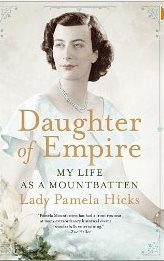
Daughter of Empire Life as a Mountbatten by Pamela Hicks


We can thank Lady Pamela Hick's younger daughter, India Hicks, for persuading her mother to pick up a pen and write her memoirs. The first volume India Remembered was published in 2007.

 Lady Pamela's first book focuses on India's independence, and roles played by her parents, Lord and Lady Mountbatten, as Viceroy and Vicereine. Now in her second book,  Daughter of Empire, Lady Pamela offers an open door to her life as a Mountbatten.

Pammy and her older sister, Patricia, have lived very priviledged but largely unorthodox lives. Lady Pamela's mother, Edwina, came from a very rich family, allowing her father, Lord Louis Mountbatten, to pursue his naval career combined with the comfort of a social position backed by his wife's bank account.

Lady Pamela was born in 1929, five years after her sister, Patricia.  She acknowledged that she and her sister barely saw their mother, as they were raised by nannies and governesses.  Lady Louis (later the Countess Mountbatten of Burma) had her charity work, but she was also a lost soul, at times,  She got bored when Lord Louis was at sea, so she took lovers. 

Lord and Lady Louis had what we would call an open marriage.  Louis was often at sea, leaving his wife with a lot of free time.  He was hurt by his wife's betrayal but eventually came to terms with it.  The marriage survived in spite of the infidelity.  They remained an effective team especially during the second world war and in India.

Lady Pamela offers an honest portrait of her parents. Having her mother spend most of a year traveling with her lover, Bunny Phillips (who later married Georgina Wernher, the eldest daughter of Lady Zia Werhner, whose sister, Nada, was married to Lord Louis' elder brother, George).  Bunny and Louis' longtime companion, Yola, became members of the family.

Lady Louis was definitely a hands-off mother, During one trip with her lover and her younger daughter (and nanny),  Lady Louis left Pammy and the nanny at a hotel in rural Hungary for some months because Lady Louis forgot where the hotel was located.

Lady Pamela has had a front-row seat in India where her father negotiated the separation of India and the birth of two independent nations: India and Pakistan.  She witnessed the marriage of her first cousin, Prince Philip of Greece, to Princess Elizabeth in 1947, and she served as Elizabeth's lady-in-waiting on the 1952 tour that included a stopover in Kenya.

She watched as Prince Philip took his wife for a walk, and told her that her beloved father was dead, and she was now Queen.  When they returned to the Sagana Lodge, Pamela wrote: "I instinctively gave her a hug but quickly, remembering that she was now Queen, dropped into a deep curtsy." 

Daughter of Empire is truly introspective, wistful, at times.  Lady Pamela's young life was shaped by historical turmoil as well as the turmoil of her parents' marriage.   Yes, her life was privileged, but I think Lady Pamela would think that it has been a privilege to live the life she has lived.

It has been an extraordinary life as a Mountbatten, but Pamela, much her parents were "slightly unsettled" by Pamela's unwillingness to embrace a public life. She was in her late 20s, unmarried, although she had turned down dozens of proposals.  One night in 1959, she went to a cocktail party, where she met a man who "bowled" her over.  His name was David Hicks, an up and coming interior designer.   They married in 1960 and became the parents of three children.

Daughter of Empire was published by (Weidenfeld & Nicolson: L20.00).

The book is scheduled to be published in the US in September 2013 by Simon & Schuster ($26.00)